第12题
若 $a>0$ ,且 $a_{n}=\underbrace{\sqrt{2+\sqrt{2+\sqrt{\cdots+\sqrt{2+a}}}}}_{n \uparrow 2}$ ,则下列说法中正确的是()
A
若 $0
B
若 $a>2$ ,则 $\lim _{n \rightarrow \infty} a_{n}=2$
C
对于任意 $a \neq 2$ ,数列极限不存在
D
若 $0
✅ 有答案
ABD . 一方面,注意到 $a_{n+1}^{2}=a_{n}+2$ ,则 $0<a<2$ 或 $a>2$ 时 $\left\{a_{n}\right\}$ 均有单调性,从而数列有极限.令 $n$ 趋向无穷,则 $x^{2}=x+2$ ,解得极限是 2 . 另一方面,若 $0<a<2$ ,利用三角换元,设 $a_{n}=2 \cos \theta_{n}\left(n \in \mathbf{N}_{+}\right)$,则 $$ 4 \cos ^{2} \theta_{n+1}=2 \cos \theta_{n}+2=2\left(2 \cos ^{2} \frac{\theta_{n}}{2}-1\right)+2=4 \cos ^{2} \frac{\theta_{n}}{2}, $$ 即 $\displaystyle \cos \theta_{n+1}=\cos \frac{\theta_{n}}{2}, \theta_{n}=\frac{\theta_{1}}{2^{n-1}}=\frac{\arccos \frac{a}{2}}{2^{n-1}}$ ,从而 $\displaystyle a_{n}=2 \cos \frac{\arccos \frac{a}{2}}{2^{n-1}}$ .
第7题
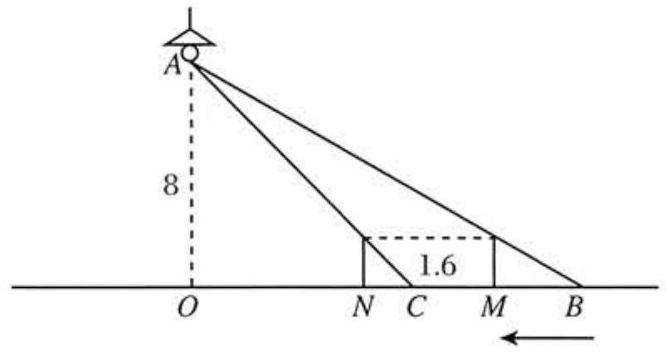
路灯距地面 8 米,一身高 1.6 米的人沿穿过灯下的直路以 84 米/分的速度行走,则人影长度的变化速率(要求以米/秒为单位)是( )。
A
$\frac{7}{20}$ 米/秒
B
$\frac{7}{2}$ 米/秒
C
$\frac{21}{20}$ 米/秒
D
21 米/秒
✅ 有答案
A. 如图 J1 所示,因为 $\displaystyle \frac{|O M|+|B M|}{|B M|}=\frac{8}{1.6}=5$ ,所以 $|O M|=4|B M|$ .同理 $|O N|=4|C N|$ .两式相减,可知人影长度的变化为 $\displaystyle |B M|-|C N|=\frac{1}{4}(|O M|-|O N|)=\frac{1}{4}|M N|=\frac{1}{4} \cdot \Delta t$ - 84 ,故 $\displaystyle V=\lim _{\Delta t \rightarrow 0} \frac{21 \Delta t}{\Delta t}=21$(米/分)$\displaystyle =\frac{7}{20}$(米/秒). \begin{figure}
第4题
\lim _{n \rightarrow \infty}\left(\frac{2^{3}-1}{2^{3}+1} \times \frac{3^{3}-1}{3^{3}+1} \times \cdots \times \frac{n^{3}-1}{n^{3}+1}\right)=$ $\_\_\_\_$ .
✅ 有答案
$\displaystyle \frac{2}{3}$ . 因为 $k^{3}-1=(k-1)\left(k^{2}+k+1\right), k^{3}+1=(k+1)\left(k^{2}-k+1\right)$ ,所以 $$ \begin{aligned} & \lim _{n \rightarrow \infty}\left(\frac{2^{3}-1}{2^{3}+1} \times \frac{3^{3}-1}{3^{3}+1} \times \cdots \times \frac{n^{3}-1}{n^{3}+1}\right) \\ & \quad=\lim _{n \rightarrow \infty}\left[\frac{1 \times 2 \times 3 \times \cdots \times(n-1)}{3 \times 4 \times 5 \times \cdots \times(n+1)} \cdot \frac{7 \times 13 \times 21 \times \cdots \times\left(n^{2}+n+1\right)}{3 \times 7 \times 13 \times \cdots \times\left(n^{2}-n+1\right)}\right] \\ & \quad=\lim _{n \rightarrow \infty}\left[\frac{2}{n(n+1)} \cdot \frac{n^{2}+n+1}{3}\right]=\frac{2}{3} \end{aligned} $$
第9题
设数列 $\left\{a_{n}\right\}$ 满足 $a_{1}=a, a_{2}=b, 2 a_{n+2}=a_{n+1}+a_{n}$ . (1)设 $b_{n}=a_{n+1}-a_{n}$ ,证明:若 $a \neq b$ ,则 $\left\{b_{n}\right\}$ 是等比数列; (2)若 $\lim _{n \rightarrow \infty}\left(a_{1}+a_{2}+\cdots+a_{n}\right)=4$ ,求 $a, b$ 的值.
✅ 有答案
(1)由 $a_{1}=a, a_{2}=b, 2 a_{n+2}=a_{n+1}+a_{n}$ ,得 $2\left(a_{n+2}-a_{n+1}\right)=-\left(a_{n+1}-a_{n}\right)$ .令 $b_{n} =a_{n+1}-a_{n}$ ,则 $\displaystyle b_{n+1}=-\frac{1}{2} b_{n}$ ,所以 $\left\{b_{n}\right\}$ 是以 $b-a$ 为首项,以 $\displaystyle -\frac{1}{2}$ 为公比的等比数列. (2)由(1)可知 $\displaystyle b_{n}=a_{n+1}-a_{n}=(b-a)\left(-\frac{1}{2}\right)^{n-1}\left(n \in \mathbf{N}^{*}\right)$ ,所以由累加法得 $\displaystyle a_{n+1}- a_{1}=(b-a) \frac{1-\left(-\frac{1}{2}\right)^{n}}{1-\left(-\frac{1}{2}\right)}$ ,即 $\displaystyle a_{n+1}=a+\frac{2}{3}(b-a)\left[1-\left(-\frac{1}{2}\right)^{n}\right]$ ,也有 $\displaystyle a_{n}=a+\frac{2}{3}(b-a)$ -$\displaystyle \left[1-\left(-\frac{1}{2}\right)^{n-1}\right](n \geqslant 2)$ .当 $n=1$ 时,$a_{1}=a$ 也适合该式.故 $\displaystyle a_{n}=a+\frac{2}{3}(b-a)$ -$\displaystyle \left[1-\left(-\frac{1}{2}\right)^{n-1}\right]\left(n \in \mathbf{N}^{*}\right)$ .于是 $$ \begin{aligned} a_{1}+a_{2}+\cdots+a_{n} & =n a+\frac{2}{3}(b-a)\left[n-\frac{1-\left(-\frac{1}{2}\right)^{n}}{1+\frac{1}{2}}\right] \\ & =n a+\frac{2}{3}(b-a) n-\frac{4}{9}(b-a)+\frac{4}{9}(b-a)\left(-\frac{1}{2}\right)^{n} \end{aligned} $$ 因为 $\lim _{n \rightarrow \infty}\left(a_{1}+a_{2}+\cdots+a_{n}\right)=4$ ,所以 $\displaystyle a+\frac{2}{3}(b-a)=0,-\frac{4}{9}(b-a)=4$ ,解得 $a= 6, b=-3$ .
第7题
方程 $x^{2}=x \sin x+\cos x$ 的实数解的个数为 $\_\_\_\_$ .
✅ 有答案
2. 记 $f(x)=x^{2}-x \sin x-\cos x$ ,则 $f^{\prime}(x)=2 x-x \cos x=x(2-\cos x)$ ,故 $f^{\prime}(0)=0$ ,可知 $f(x)$ 在 $(-\infty, 0)$ 上单调递减,在 $(0,+\infty)$ 上单调递增.又 $f(0)=-1, \lim _{x \rightarrow-\infty} f(x)=+\infty$ , $\lim _{x \rightarrow+\infty} f(x)=+\infty$ ,故 $f(x)$ 有两个零点.
第2题
设双曲线 $x^{2}-y^{2}=1$ 的左、右焦点分别为 $F_{1}, F_{2}$ ,若 $\triangle P F_{1} F_{2}$ 的顶点 $P$ 在第一象限的双曲线上移动,求 $\triangle P F_{1} F_{2}$ 的内切圆的圆心轨迹以及该内切圆在边 $P F_{2}$ 上的切点轨迹。
✅ 有答案
记双曲线在 $x$ 轴上的两顶点为 $A(1,0), B(-1,0), G$ 为 $\triangle P F_{1} F_{2}$ 的内切圆在边 $F_{1} F_{2}$ 上的切点,$H$ 为 $\triangle P F_{1} F_{2}$ 的内切圆在边 $P F_{2}$ 上的切点,$K$ 为 $\triangle P F_{1} F_{2}$ 的内切圆在边 $P F_{1}$ 上的切点,则有 $$ \begin{aligned} \left|G F_{1}\right|-\left|G F_{2}\right| & =\left|K F_{1}\right|-\left|H F_{2}\right|=\left(\left|K F_{1}\right|+|K P|\right)-\left(\left|H F_{2}\right|+|H P|\right) \\ & =\left|P F_{1}\right|-\left|P F_{2}\right| \end{aligned} $$ 由双曲线的定义知,$G$ 必在双曲线上,于是 $G$ 与 $A(1,0)$ 重合,是定点. 而 $\left|F_{2} G\right|=\left|F_{2} A\right|=\sqrt{2}-1$ .根据圆外一点到该圆的两切点的距离相等,所以 $\triangle P F_{1} F_{2}$的内切圆在边 $P F_{2}$ 上的切点的轨迹是以 $F_{2}(\sqrt{2}, 0)$ 为圆心、 $\sqrt{2}-1$ 为半径的圆弧. 因为 $P(x, y)$ 在 $x^{2}-y^{2}=1$ 第一象限的曲线上移动,当 $P F_{2}$ 沿双曲线趋于无穷时,与 $x$轴正向的交角 $\theta$ 的正切的极限是 $\displaystyle \lim _{x \rightarrow+\infty} \tan \theta=\lim _{x \rightarrow+\infty} \frac{\sqrt{x^{2}-1}}{x-\sqrt{2}}=1$ ,即 $\displaystyle \theta \rightarrow \frac{\pi}{4}$ .故点 $H$ 的轨迹方程为(极坐标形式) $$ \left\{\begin{array}{l} x-\sqrt{2}=(\sqrt{2}-1) \cos \theta, \\ y=(\sqrt{2}-1) \sin \theta \end{array} \quad\left(\frac{\pi}{4}<\theta<\pi\right) .\right. $$ 由于 $G$ 与 $A(1,0)$ 重合,是定点,故该内切圆的圆心轨迹是直线段,方程为 $x=1(0<y <1$ ).
第13题
\lim _{n \rightarrow \infty} \sum_{k=1}^{n} \frac{1}{1+2+\cdots+k}=(\quad)$ .
A
4
B
$\frac{1}{2}$
C
1
D
2
✅ 有答案
D. $$ \sum_{k=1}^{n} \frac{2}{k(k+1)}=2 \sum_{k=1}^{n}\left(\frac{1}{k}-\frac{1}{k+1}\right)=2-\frac{2}{n+1} . $$
第19题
已知正项数列 $\left\{a_{n}\right\}$ 满足 $a_{1}=3$ ,且 $a_{1} a_{2} \cdots a_{n}=a_{1}+a_{2}+\cdots+a_{n}\left(n \in \mathbf{N}^{*}\right)$ .证明这个数列是单调递减数列,并求 $\lim _{n \rightarrow \infty} a_{n}$ 的值.
✅ 有答案
(1) $$ \left\{\begin{array}{l} a_{1} a_{2} a_{3} \cdots a_{n}=a_{1}+a_{2}+a_{3}+\cdots+a_{n}, \\ a_{1} a_{2} a_{3} \cdots a_{n} a_{n+1}=a_{1}+a_{2}+a_{3}+\cdots+a_{n}+a_{n+1}, \end{array}\right. $$ 两式相减得 $a_{1} a_{2} \cdots a_{n}\left(a_{n+1}-1\right)=a_{n+1}$ .同理得 $a_{1} a_{2} \cdots a_{n} a_{n+1}\left(a_{n+2}-1\right)=a_{n+2}$ .因此 $a_{n}>1\left(n \in \mathbf{N}^{*}\right)$ .于是两式相除得 $\displaystyle \frac{a_{n+1}\left(a_{n+2}-1\right)}{a_{n+1}-1}=\frac{a_{n+2}}{a_{n+1}}$ ,所以 $\displaystyle a_{n+1} \cdot \frac{a_{n+2}-1}{a_{n+2}}=\frac{a_{n+1}-1}{a_{n+1}}$ . 又因为 $a_{n+1}>1$ ,所以 $\displaystyle \frac{a_{n+2}-1}{a_{n+2}}<\frac{a_{n+1}-1}{a_{n+1}}$ ,故有 $a_{n+2}<a_{n+1}$ . 又因为 $\displaystyle a_{1}=3,3 a_{2}=3+a_{2}, a_{2}=\frac{3}{2}$ ,所以 $a_{2}<a_{1}$ .于是 $a_{n+1}<a_{n}\left(n \in \mathbf{N}^{*}\right)$ ,即 $\left\{a_{n}\right\}$ 是单调递减数列. (2)由于 $\left\{a_{n}\right\}$ 单调递减且 $a_{n}>1$ ,故 $\lim _{n \rightarrow \infty} a_{n}$ 存在,并设 $\lim _{n \rightarrow \infty} a_{n}=A$ ,则 $A \geqslant 1$ . 因为 $\displaystyle a_{n+1} \cdot \frac{a_{n+2}-1}{a_{n+2}}=\frac{a_{n+1}-1}{a_{n+1}}$ ,所以两边取极限得 $\displaystyle A \cdot \frac{A-1}{A}=\frac{A-1}{A}$ ,即 $(A-1)^{2}=0$ ,解得 $A=1$ ,即 $\lim _{n \rightarrow \infty} a_{n}=1$ .
第11题
数列 $\left\{a_{n}\right\}$ 满足 $a_{1}=3, a_{n+1}=a_{n}^{2}-3 a_{n}+4$ ,则( ).
A
$\left\{a_{n}\right\}$ 单调递增
B
$\left\{a_{n}\right\}$ 无上界
C
$\lim _{n \rightarrow+\infty} \sum_{i=1}^{n} \frac{1}{a_{i}-1}=1$
✅ 有答案
ABC . 易知 $a_{n} \neq 0$ ,且 $a_{n+1}=a_{n}^{2}-3 a_{n}+4$ ,则 $a_{n+1}-a_{n}=\left(a_{n}-2\right)^{2}>0,\left\{a_{n}\right\}$ 单调递增. 又 $\displaystyle a_{1}=3>\frac{3}{2}$(二次函数对称轴),则 $\left\{a_{n}\right\}$ 无上界,而 $\displaystyle \frac{1}{a_{n+1}-2}-\frac{1}{a_{n}-2}=-\frac{1}{a_{n}-1}$ ,则 $$ \sum_{i=1}^{n} \frac{1}{a_{i}-1}=1-\frac{1}{a_{n+1}-2} \Rightarrow \lim _{n \rightarrow+\infty} \sum_{i=1}^{n} \frac{1}{a_{i}-1}=1 $$
第11题
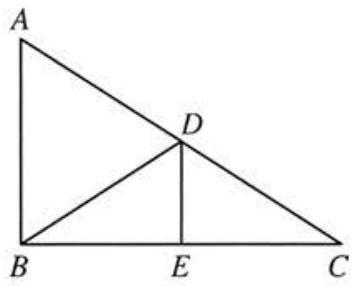
如图 2 所示,在 Rt $\triangle A B C$ 中,$\angle A B C=90^{\circ}$ ,斜边 $A C$ 上有一点 $D$ 使得 $|A B|= |A D|, E$ 为 $B C$ 上一点使得 $\angle B A D=\angle B D E=\theta$ ,则 $\displaystyle \lim _{\theta \rightarrow 0^{+}} \frac{|B E|}{|B C|}=$ $\_\_\_\_$。
✅ 有答案
$\displaystyle \frac{2}{3}$ . 设 $|A B|=a$ ,则 $|B C|=a \tan \theta$ .因为 $|A B|=|A D|$ ,所以 $\displaystyle \angle D B E=\frac{\theta}{2},|B D|=2 a \sin \frac{\theta}{2}$ , $\displaystyle \frac{|B E|}{\sin \theta}=\frac{|B D|}{\sin \angle B E D}=\frac{|B D|}{\sin \frac{3}{2} \theta}$ ,故 $$ \begin{aligned} |B D| & =\frac{2 a \sin \frac{\theta}{2} \sin \theta}{\sin \frac{3}{2} \theta} \\ \frac{|B E|}{|B C|} & =\frac{2 \sin \frac{\theta}{2} \cos \theta}{\sin \frac{3}{2} \theta}=\frac{2 \sin \frac{\theta}{2} \cos \theta}{\sin \theta \cos \frac{\theta}{2}+\cos \theta \sin \frac{\theta}{2}} \\ & =\frac{2 \tan \frac{\theta}{2}}{\tan \theta+\tan \frac{\theta}{2}}=\frac{2\left(1-\tan ^{2} \frac{\theta}{2}\right)}{3-\tan ^{2} \frac{\theta}{2}} \end{aligned} $$ 故 $\displaystyle \lim _{\theta \rightarrow 0^{+}} \frac{|B E|}{|B C|}=\frac{2}{3}$ .
第19题
f(x)=\ln \frac{\mathrm{e}^{x}-1}{x}, a_{1}=1, a_{n+1}=f\left(a_{n}\right)$ . (1)求证: $\mathrm{e}^{x} x-\mathrm{e}^{x}+1 \geqslant 0$ 恒成立; (2)试求 $f(x)$ 的单调区间; (3)求证:$\left\{a_{n}\right\}$ 为递减数列,且 $a_{n}>0$ 恒成立.
✅ 有答案
(1)令 $g(x)=\mathrm{e}^{x} x-\mathrm{e}^{x}+1$ ,求导得 $g^{\prime}(x)=\mathrm{e}^{x} x$ .当 $x<0$ 时,$g^{\prime}(x)<0$ ;当 $x>0$ 时, $g^{\prime}(x)>0$ .所以 $g(x)$ 在 $(-\infty, 0)$ 上为减函数,在 $(0,+\infty)$ 上为增函数.故 $g(x) \geqslant g(0)=0$ ,即 $\mathrm{e}^{x} x-\mathrm{e}^{x}+1 \geqslant 0$ 恒成立。 (2)对 $\displaystyle f(x)=\ln \frac{\mathrm{e}^{x}-1}{x}$ 求导,得 $$ f^{\prime}(x)=\frac{x}{\mathrm{e}^{x}-1} \cdot\left(\frac{\mathrm{e}^{x}-1}{x}\right)^{\prime}=\frac{x}{\mathrm{e}^{x}-1} \cdot \frac{\mathrm{e}^{x} x-\mathrm{e}^{x}+1}{x^{2}} . $$ 由(1)知,当 $x \neq 0$ 时, $\mathrm{e}^{x} x-\mathrm{e}^{x}+1>0$ .又当 $x>0$ 时, $\mathrm{e}^{x}-1>0$ ;当 $x<0$ 时, $\mathrm{e}^{x}-1<0$ .故 $\displaystyle \frac{x}{\mathrm{e}^{x}-1}>0$ ,则 $f^{\prime}(x)>0$ 恒成立.因为 $f(x)$ 的定义域为 $(-\infty, 0) \cup(0,+\infty)$ ,所以 $f(x)$ 的单调增区间为 $(-\infty, 0) \cup(0,+\infty)$ 。 (3)用数学归纳法证明:对于任意 $n \in \mathbf{N}^{*}$ ,都有 $0<a_{n+1}<a_{n}$ . (1)当 $n=1$ 时,$a_{1}=1, a_{2}=f\left(a_{1}\right)=f(1)=\ln (\mathrm{e}-1)$ .由于 $1<\mathrm{e}-1<\mathrm{e}$ ,所以 $0<\ln (\mathrm{e}-1) <1$ ,即 $0<a_{2}<a_{1}$ . (2)假设当 $n=k\left(k \in \mathbf{N}^{*}\right)$ 时结论成立,即 $0<a_{k+1}<a_{k}$ .因为 $f(x)$ 在 $(0,+\infty)$ 上为增函数,且 $\displaystyle \lim _{x \rightarrow 0^{+}} f(x)=\lim _{x \rightarrow 0^{+}}\left(\ln \frac{\mathrm{e}^{x}-1}{x}\right)=\ln \left(\lim _{x \rightarrow 0^{+}} \frac{\mathrm{e}^{x}-1}{x}\right)=\ln 1$(这里用到了洛必达法则)$=0$ ,所以 $0<f\left(a_{k+1}\right)<f\left(a_{k}\right)$ ,即 $0<a_{k+2}<a_{k+1}$ .因此当 $n=k+1\left(k \in \mathbf{N}^{*}\right)$ 时结论也成立. 由(1)和(2)可知, $0<a_{k+1}<a_{k}$ 对于任意 $n \in \mathbf{N}^{*}$ 都成立.故数列 $\left\{a_{n}\right\}$ 为递减数列,且 $a_{n}>0$ 恒成立.
第3题
$\lim _{n \rightarrow \infty} \sqrt{6+\sqrt{6+\cdots+\sqrt{6}}}$ 的值是 $\_\_\_\_$ .
✅ 有答案
3. 令 $a_{n}=\sqrt{6+\sqrt{6+\cdots+\sqrt{6}}}$ ,则 $a_{n+1}=\sqrt{a_{n}+6}\left(n \in \mathbf{N}^{*}\right)$ .用数学归纳法易证明 $a_{n}< a_{n+1}<3$ ,所以数列 $\left\{a_{n}\right\}$ 存在极限,记 $A=\lim _{n \rightarrow \infty} a_{n}$ ,对 $a_{n+1}=\sqrt{a_{n}+6}$ 两边求极限,得 $A= \sqrt{A+6}$ ,解得 $A=3$ .
共 12 题